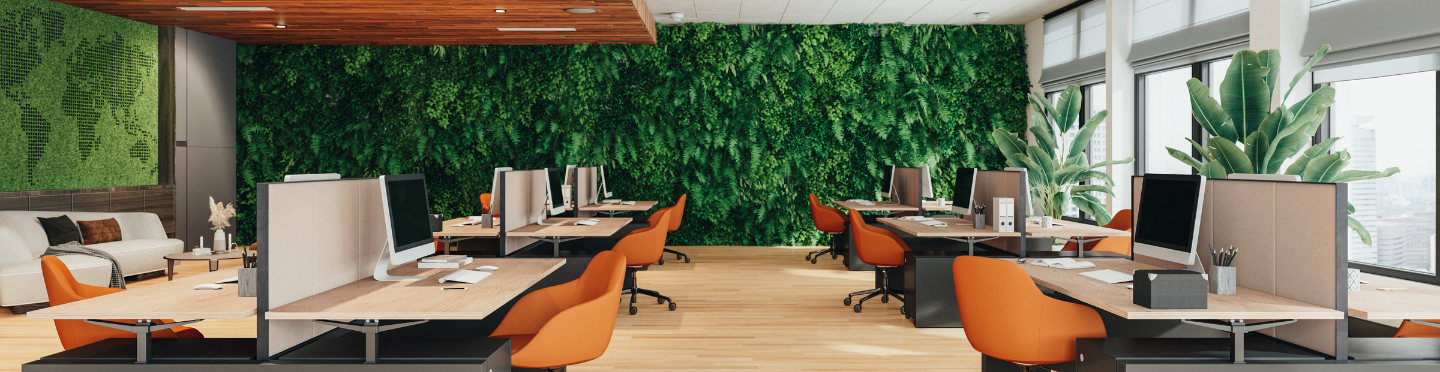
Under work health and safety laws, employers must ensure, as far as reasonably practicable, that work areas have adequate space and lighting for work to be carried out safely. People must be able to enter and leave the workplace, and move about in it safely, both under normal working conditions and to facilitate safe evacuation in an emergency (reg 40 of the WHS Regulations).
Office Space
If there is adequate space for storage and for the movement of people, it will be easier to maintain a reasonable standard of housekeeping, with the workplace clean and tidy.
Space for aisles, passages and access to other areas is needed in addition to the space around workstations. The Model Code of practice: Managing the work environment and facilities notes that there should also be enough space in walkways and around cupboards, storage or doors, in addition to the clear workstation space.
In Victoria, occupational health and safety laws are consistent with WHS requirements in that it is considered essential to provide adequate space in an office to enable workers to operate effectively.
The Victorian publication Officewise: A guide to health and safety in the office handbook advises that three types of space need to be considered:
-
primary space – amenities, meeting rooms, lift lobbies, and similar areas
-
secondary space – corridors and storage, and
-
tertiary space – space required in a workstation to accommodate a desk, chair, drawers, filing cabinet, and other necessary equipment. For example, a filing cabinet requires about 1.2 metres of space in front of it to enable someone to access a fully opened bottom drawer. If this projects into a frequently used walkway it becomes an obstruction and a hazard will be created.
The Victorian guide recommends a minimum of six square metres per person for tertiary space and additional space for secondary and primary space requirements.
The Australian Standard, AS 1668.2-2024 The use of ventilation and air conditioning in buildings – Mechanical ventilation in buildings recommends an overall 10 square metres per person for offices, including primary, secondary, and tertiary spaces.
Where equipment such as photocopiers, faxes, and printers are used, there is a need to accommodate the equipment and allow for additional traffic and general activity.
Office Lighting
As with space, the key principle is that lighting must be adequate for people to carry out their work safely, and for people to enter and leave the workplace and move about in it safely, both under normal working conditions and in an emergency.
Visual comfort in an office environment is often considered in relation to screen-based work, as glare or reflections on the screen may cause employees to adopt awkward postures that can cause strain if maintained over a long period.
For computer-based work, it is generally recommended that the monitor should be positioned to the side of the light source. Ideally, the monitor should not be located near a window. If this is unavoidable, the monitor should be at a 90-degree angle (right angle) to the window, that is, side-on and not parallel to the window.
The reasons for this are that if direct sunlight is coming in from behind the person, it may cause reflections on the screen; alternatively, if the person is facing a window directly behind the monitor, the contrasting brightness from the window may cause eye strain for someone who needs to spend most of their time looking at the screen. A good practice is to have the screen as the brightest object in a person’s visual field.
AS/NZS 1680.1:2006 Interior and workplace lighting – General principles and recommendations provides general principles and recommendations for the lighting of building interiors to enhance the performance and comfort of those performing visual tasks. It deals with illuminating essential task details, using both artificial light and daylight while controlling or excluding factors that might cause visual discomfort.